
informational 6 min read
Bramante Staircase: How to See It in the Vatican Museums
Updated October 28, 2026
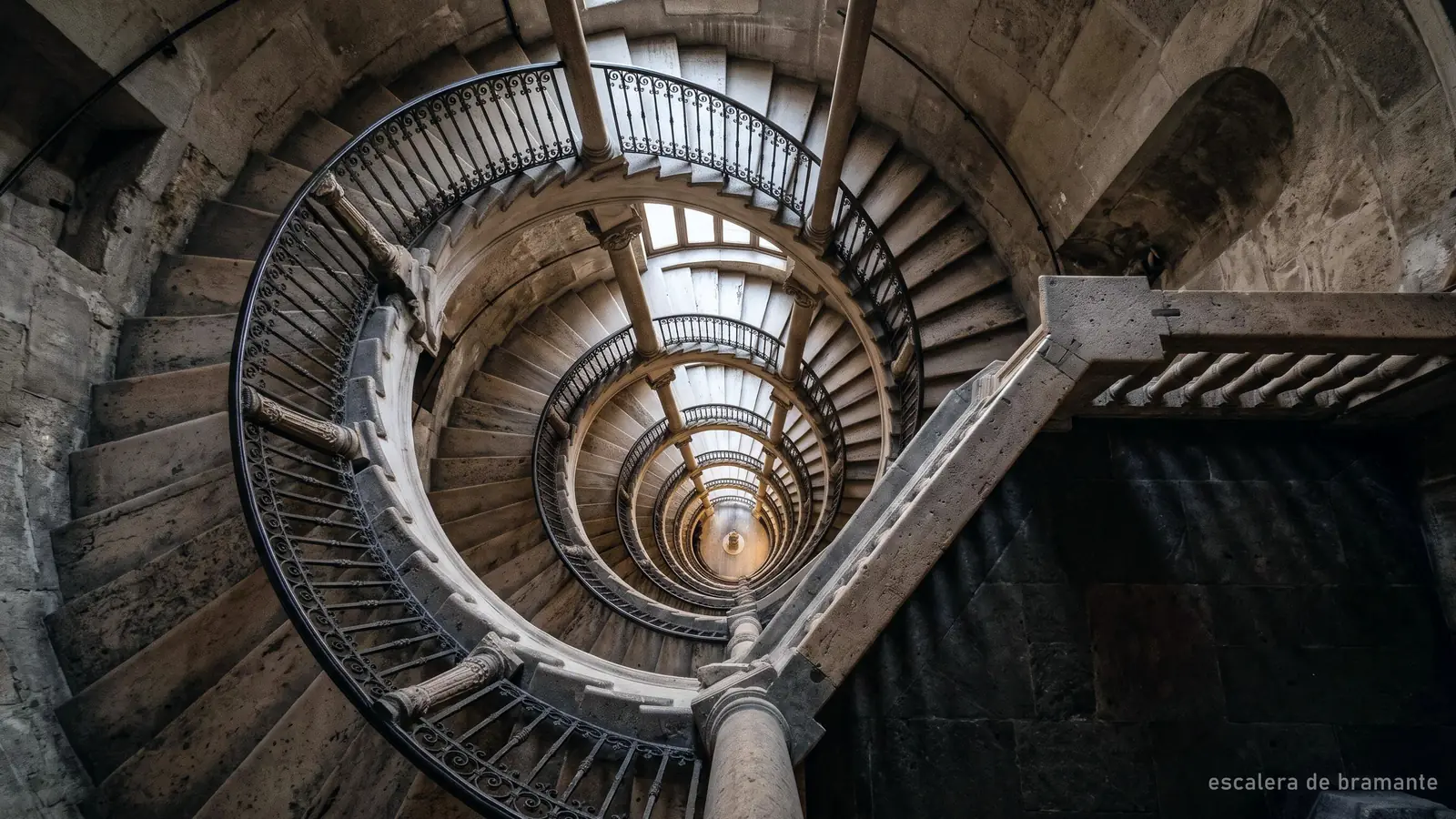
The original Bramante staircase can almost never be seen: it is usually closed to the public for conservation, and opens only by appointment and for research purposes. The spiral staircase almost everyone photographs in the Vatican Museums is a different one: Giuseppe Momo’s double helix, from 1932, which you find at the end of the route. That one you do see with a standard ticket. The two are often confused because Momo’s copies Bramante’s idea.
The two staircases: Bramante’s and Momo’s
| Bramante staircase | Momo staircase | |
|---|---|---|
| Architect | Donato Bramante | Giuseppe Momo |
| Year | 1507 | 1932 |
| Inspiration | Original work | Bramante’s ramp |
| Shape | Helical ramp without steps | Double helix |
| Where | Building next to the Octagonal Court of the Belvedere (Pio-Clementino Museum) | End of the Museums route |
| Can you see it with your ticket? | No, usually closed | Yes |
Bramante’s links the small palace of Innocent VIII, known as the Belvedere casino and designed by Antonio del Pollaiolo (1485–1487), to the rest of the Apostolic Palaces. It is a spiral ramp supported by Doric, Ionic and Corinthian columns, with a continuous architrave. Regularly spaced windows let in the light from outside.
Momo’s is inspired by it. Giuseppe Momo was also the architect who, after the Lateran Pacts of 1929, planned the current layout of the Vatican Gardens with the botanist Giovanni Nicolini, according to the Museums themselves.
What did Donato Bramante build?
Donato Bramante (1444–1514) was Julius II’s most important architect. He worked first in Milan, where he collaborated with Leonardo da Vinci, and settled in Rome in 1499. There he built the cloister of Santa Maria della Pace (1500) and the Tempietto of San Pietro in Montorio (1503).
In 1504 Julius II made him superintendent general of papal building works. In that role he began the project for the new St Peter’s Basilica, with a Greek-cross plan that Michelangelo later took up again. He also designed the great Belvedere Courtyard, on three levels, to link the small palace of Innocent VIII to the Apostolic Palace. Bramante died in 1514 without seeing it finished. The helical ramp is one of the pieces of that project.
How many steps does the Vatican staircase have?
The Bramante staircase has none. Despite the name, it is a ramp: the floor is laid in a herringbone pattern and has no steps. A small metal handrail was added later. The story goes that Bramante designed it this way so Julius II could reach his residence without leaving his carriage.
Momo’s, on the other hand, is a double-helix staircase. No official source publishes how many steps it has, so we will not give you an invented figure. What is useful is knowing where it is: at the end of the route, on your way to the exit.
Where each staircase is
- Bramante. In an annex to the Octagonal Court of the Belvedere Palace, the building that now houses the Pio-Clementino Museum. It is the same area as Laocoön and His Sons, although the ramp is not part of the open route.
- Momo. At the end of the Vatican Museums route. You reach it once you have seen the galleries and are heading for the exit.
The ramp within the great Belvedere project
The ramp was not a stand-alone work. It was part of the Belvedere Courtyard, the great three-level space with which Bramante wanted to link the small palace of Innocent VIII to the rest of the Apostolic Palaces. He designed a facade of pilasters in regular bays and, at the center, a large open apse, the so-called Nicchione, with fan-shaped steps that soon became known as “Bramantesque”. At one end he placed the helical ramp to climb up to the terrace. Later, Pirro Ligorio added a semicircular colonnade on commission from Julius III.
That courtyard was later divided into three: the Belvedere Court, the Library Court and the Court of the Pine Cone. Today it is heavily altered, and Bramante never saw it finished. Giorgio Vasari wrote about these ramps.
Can you see the Bramante staircase?
Not with the standard ticket. The ramp is usually closed for its protection and conservation, except by appointment and for research purposes. None of the nine tickets and tours we sell mentions it in its description.
What you can do:
- See Momo’s staircase, which is on the normal route and is the one almost everyone calls “the Vatican staircase”.
- Notice its legacy. Bramante’s ramp served as a model for other helical staircases: the one at Villa Madama, by Raphael; the one at the villa of Caprarola, by Jacopo Vignola; and even the one at the Château de Chambord, which some attribute to Leonardo.
- Check the Museums’ official website if you have a study reason, since access to the original ramp is granted by appointment.
How to see it on your visit
- Ticket. The Momo staircase is covered by the standard ticket: 20 € at the ticket office or 20 € + 5 € when booked online on the official website, valid only for the day issued. If you want to book and skip the line, the Vatican Museums and Sistine Chapel ticket costs from $37 (partner price converted from euros at 1 EUR = 1.115 USD, ECB, 27 Oct 2026).
- Mind the order. Some guided tours end in the Sistine Chapel and go straight on to St Peter’s Basilica without returning to the end of the route. If you want the staircase photo, ask beforehand whether your tour exits that way.
- Photos. You can take photos without flash for personal use throughout the museum except in the Sistine Chapel. Tripods and selfie sticks are not allowed.
- Time. The full route is about 7 km of galleries. To work out how long it will take you, see how long the Vatican Museums take.
- Hours. Monday to Saturday from 8:00 to 20:00, last entry at 18:00. The rooms start emptying 30 minutes before closing, so do not leave your exit to the last minute.
Check prices & dates
Book your tickets in advance: popular time slots sell out.
Book Vatican tickets
From$37per person
Check availability- Free cancellation on 8 of the 9 options
- Reserve now, pay later on 7 of the 9
- Compared with the official 20 € + 5 € ticket
Price checked Oct 27, 2026
Frequently asked questions
Can you see the Bramante staircase?
Usually not. Bramante's original ramp is normally closed to the public to protect it, except by appointment and for research purposes. The spiral staircase almost everyone sees is Giuseppe Momo's, from 1932, at the end of the Museums route.
Who designed the spiral staircase in the Vatican Museums?
The double helix you see as you leave the Museums is by Giuseppe Momo and dates from 1932. It is inspired by the ramp Donato Bramante designed in 1507 for Julius II.
Does the Bramante staircase have steps?
No. It is a helical ramp without steps, with a herringbone floor. That is why it is said to have been designed so the Pope could ride up without leaving his carriage.
Do you need a special ticket to see the Momo staircase?
No. It is on the Vatican Museums route, so you see it with the standard ticket, the same one that includes the Sistine Chapel.
Sources