
informational 6 min read
Laocoön and His Sons: Where to See It in the Vatican Museums
Updated October 28, 2026
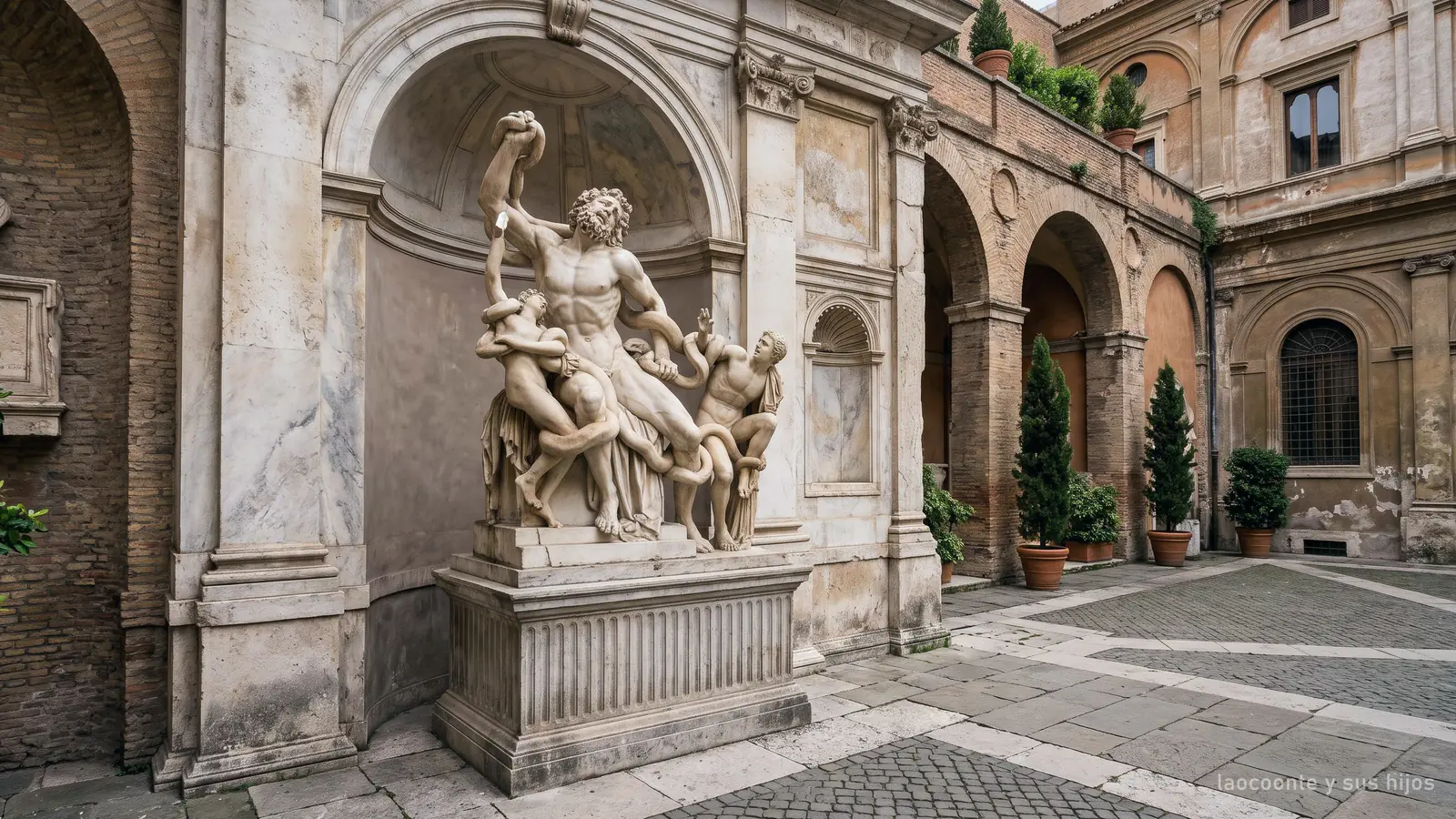
Laocoön and His Sons stands in the Octagonal Court of the Pio-Clementino Museum, one of the first stretches of the Vatican Museums route. It is a 2.42-meter white marble group showing the Trojan priest Laocoön and his two sons attacked by sea serpents. You see it with the standard Museums ticket, which also includes the Sistine Chapel. You need no separate ticket.
What the Laocoön and His Sons group depicts
The sculpture shows three bodies caught by two serpents. At the center is Laocoön, his torso straining and his face contorted. On either side are his two sons, smaller than their father. The composition is pyramidal and meant to be seen from the front.
Wikipedia notes that the group has been called “the prototypical icon of human agony” in Western art. Laocoön’s eyebrows are so strained that the physician Guillaume-Benjamin Duchenne described them as impossible on a real face. The style is associated with the Hellenistic Baroque of Pergamon, whose best-known work is the Pergamon Altar, now in Berlin.
What is the legend of Laocoön and his sons?
The story takes place during the siege of Troy. The Greeks leave the wooden horse outside the city. Laocoön, priest of the temple of Apollo Thymbraeus, warns the Trojans that it is a trap and even hurls a spear at the horse.
Shortly afterward, as he prepares to sacrifice a bull to Poseidon, two serpents emerge from the sea. They attack his sons first, whom the sources call Antiphantes and Thymbraeus (or Melanthus). Laocoön tries to save them and dies with them. The Trojans read the scene as a sign that the horse was sacred and bring it into the city.
The best-known telling is in Book II of Virgil’s Aeneid, where the father and both sons die. In an earlier version, from a lost poem of the Trojan cycle, only one of the sons dies.
Was Laocoön Greek or Trojan?
Laocoön was Trojan: a priest of Troy, on the opposite side from the Greeks. The sculpture, however, is Greek in style and authorship. Pliny the Elder attributed it to three sculptors from the island of Rhodes: Agesander, Polydorus and Athenodoros.
The date is still debated. Proposals range from 200 BC to the AD 70s. Today the most widely accepted is the Julio-Claudian period, between 27 BC and AD 68. Nor is there agreement on whether it is an original or a marble copy of an earlier bronze.
Why was Laocoön punished?
The myths give two explanations:
- For attacking the horse. In Virgil’s tradition, the serpents are divine punishment for trying to destroy the Trojan Horse. That is how the Trojans understood it.
- For offending Apollo. Another version says that Laocoön had taken a vow of celibacy as a priest of Apollo, married Antiope and had children, and that the punishment came for that sacrilege.
The sources do not agree either on which god sent the serpents: Apollo, Poseidon or Athena, depending on the author.
Where is the Laocoön in the Vatican Museums?
It is in the Octagonal Court of the Belvedere, which today is part of the Pio-Clementino Museum. It is the same courtyard where Julius II placed the Laocoön, the Apollo Belvedere and the Venus Felix in 1509, each in a niche. Wikipedia notes that, together with the Belvedere Torso, it is the only Greek original in that collection.
The Pio-Clementino comes early in the visit. On the itinerary of one of the guided tours we sell, the Pio-Clementino Museum stop comes before the Gallery of the Candelabra, the Gallery of Maps, the Gallery of Tapestries, the Raphael Rooms and the Sistine Chapel. If you go on your own, follow the signs to the Pio-Clementino at the start, before the route sends you one way toward the Sistine.
| Fact | Laocoön and His Sons |
|---|---|
| Room | Octagonal Court, Pio-Clementino Museum |
| Material | White marble |
| Height | 2.42 m |
| Sculptors according to Pliny | Agesander, Polydorus and Athenodoros of Rhodes |
| Most accepted date | Julio-Claudian period (27 BC–AD 68) |
| Discovered | 14 January 1506, Esquiline (Rome) |
| In the Vatican since | 1509 |
| Ticket | Included in the standard Museums ticket |
Why the Laocoön matters so much
Its importance comes as much from the work itself as from its history in Rome.
Its discovery helped found the Vatican Museums. The group turned up on 14 January 1506 in a vineyard on the Esquiline, on land that had been part of Nero’s Domus Aurea. Julius II sent the architect Giuliano da Sangallo, who went with Michelangelo. The two identified it as the work Pliny had praised in the palace of Emperor Titus. The Pope bought it for more than 600 ducats and in 1509 installed it in the Belvedere Courtyard next to the Apollo Belvedere. That private collection of Julius II is the origin of the Vatican Museums.
The lost arm. When it was discovered, the father’s right arm was missing. Michelangelo argued that it should be bent and even carved one, which was never fitted. The 16th-century restorations set it outstretched. In 1905 the archaeologist Ludwig Pollack found the original arm in a shop on Via Labicana: it was bent, as Michelangelo had proposed. In the 1957–1960 restoration, led by Filippo Magi, it was put back and the additions were removed.
A trip to Paris. In 1798, after the Treaty of Tolentino, Napoleon’s army took the group to the Louvre. It returned to the Vatican in 1816.
A work for study. Winckelmann, Lessing and Goethe wrote about it. Lessing’s 1766 essay on the limits between painting and poetry bears its name.
How to fit it into your visit
- Ticket. The standard ticket costs 20 € at the ticket office or 20 € + 5 € when booked online on the official website, and is valid only for the day issued. If you would rather not queue, the Vatican Museums and Sistine Chapel ticket costs from $37 (partner price converted from euros at 1 EUR = 1.115 USD, ECB, 27 Oct 2026).
- Hours. Monday to Saturday from 8:00 to 20:00, last entry at 18:00. Before you go, check the Vatican Museums hours and closing days.
- Photos. In the Octagonal Court you can take photos without flash for personal use. Tripods and selfie sticks are not allowed.
- What else to see nearby. The Apollo Belvedere and the Belvedere Torso are in the same museum. For the rest of the collection, see our list of Vatican Museums highlights you should not miss.
If you are curious how Julius II’s collection became a museum, we tell the story in the history of the Vatican. And if you are looking for another Belvedere piece from the same period, Bramante’s ramp is in the same building: we explain it in the guide to the Bramante staircase.
Check prices & dates
Book your tickets in advance: popular time slots sell out.
Book Vatican tickets
From$37per person
Check availability- Free cancellation on 8 of the 9 options
- Reserve now, pay later on 7 of the 9
- Compared with the official 20 € + 5 € ticket
Price checked Oct 27, 2026
Frequently asked questions
Where is the Laocoön?
In the Octagonal Court of the Pio-Clementino Museum, inside the Vatican Museums. You see it with the regular Museums ticket, the same one that includes the Sistine Chapel.
Who made the Laocoön?
Pliny the Elder attributed it to three sculptors from Rhodes: Agesander, Polydorus and Athenodoros. The date is debated; the most widely accepted proposal today is the Julio-Claudian period, between 27 BC and AD 68.
How big is the Laocoön?
It is 2.42 meters tall and carved in white marble, slightly larger than life size.
Can you take photos of the Laocoön?
Yes. In the Vatican Museums you can take photos for personal use without flash in every room except the Sistine Chapel. Tripods and selfie sticks are not allowed.
When was the Laocoön discovered?
On 14 January 1506, in a vineyard on the Esquiline, near St Mary Major. Julius II bought it and in 1509 moved it to the Belvedere Courtyard.
Sources