
informational Pillar guide 10 min read
Vatican Museum Guide: What to See, the Route and a Map of Rooms
Updated October 28, 2026
In the Vatican Museum you see the popes’ art collections: Greek and Roman sculpture in the Pio-Clementino Museum, the Gallery of Maps, the Raphael Rooms, the Pinacoteca and, at the end of the route, Michelangelo’s Sistine Chapel. There are 27 museums, galleries, chapels and rooms joined in a route of about seven kilometers, and a single ticket covers them all. Allow 2 to 3 hours for the main sights. The official ticket costs 20 € at the ticket office or 20 € + 5 € online, and the Vatican Museums are open Monday to Saturday from 8:00 a.m. to 8:00 p.m., with last entry at 6:00 p.m.
What are the Vatican Museums, and how many museums do they include?
The Vatican Museums are the Catholic Church’s group of art galleries and rooms open to the public in Vatican City. They started with the private collection of Julius II, elected pope in 1503, who brought his sculptures to the Belvedere courtyard, today’s Octagonal Court. The Apollo Belvedere was already there, as was the Laocoön group, found on 14 January 1506 in Nero’s Domus Aurea and identified by the architect Giuliano da Sangallo.
The popes who followed kept expanding the collection:
- 1771: Clement XIV founds the Pio-Clementino Museum, the first Vatican museum, later enlarged by Pius VI.
- 1800: Pius VII commissions the Chiaramonti Museum from Antonio Canova.
- 1837 and 1839: Gregory XVI opens the Gregorian Etruscan Museum and the Gregorian Egyptian Museum.
- 1932: the Vatican Pinacoteca opens on 27 October, in a building by Luca Beltrami.
- 2007: the Philatelic and Numismatic Museum opens, the latest collection added, with Vatican stamps and coins since 1929. We cover it in Vatican coins and stamps.
Today Wikipedia lists 27 units: the Gregorian Egyptian Museum, the Gregorian Etruscan, the Pio-Clementino, the Chiaramonti, the Lapidary Gallery, the Braccio Nuovo, the Gregorian Profane, the Pio Christian, the Pinacoteca, the Anima Mundi Ethnological Museum, the Carriage Pavilion, the Gallery of Maps, the Collection of Modern and Contemporary Art, the Sistine Chapel, the Raphael Rooms, the Borgia Apartments and the Niccoline Chapel, among other rooms and chapels. Two archaeological areas are added to these. The Vatican Library also belongs to the complex, and since 1929 all the museums have come under the Governorate of the Vatican City State.
They are also among the most visited museums in the world: 6,883,000 visitors in 2019 and 5,080,866 in 2022, when they were the second most visited after the Louvre.
Where are the Vatican Museums, and where is the entrance?
The Museums entrance is on Viale Vaticano, on Italian territory, beside the Vatican walls, not in St. Peter’s Square. It is the most common mistake: the square and the basilica are on the other side of the complex, a walk away outside the walls.
The current entrance, on the north side of the walls, opened in February 2000. The old 1932 entrance, a spiral ramp by Giuseppe Momo, now serves as the exit.
To get there, the metro is easiest: line A, toward Battistini, to Ottaviano or Cipro. Bus 49 stops opposite the Museums, and there is a taxi rank in front. Every option is in how to get to the Vatican.
On the way in you go through an airport-style security check. Large bags, umbrellas and tripods go to the cloakroom, which is free. Wheelchairs are also lent there free of charge, against an ID document as a deposit.
What is the route through the Vatican Museums to the Sistine Chapel?
The route runs one way and ends in the Sistine Chapel. You can extend it by stepping into side rooms, but the main line is the same for everyone. This table follows the order of the itineraries of the visits we sell and works as a map of the Vatican Museums to find your way:
| Section | What to see | Fact |
|---|---|---|
| 1. Belvedere courtyard and Pinacoteca | Paintings from the 12th to the 19th century | About 500 works in 18 rooms |
| 2. Pio-Clementino Museum | Laocoön, Apollo Belvedere, Belvedere Torso | Twelve rooms and the Octagonal Court |
| 3. Galleries of the Candelabra and of Tapestries | Flemish tapestries from the 15th to the 17th century | The tapestries have hung here since 1838 |
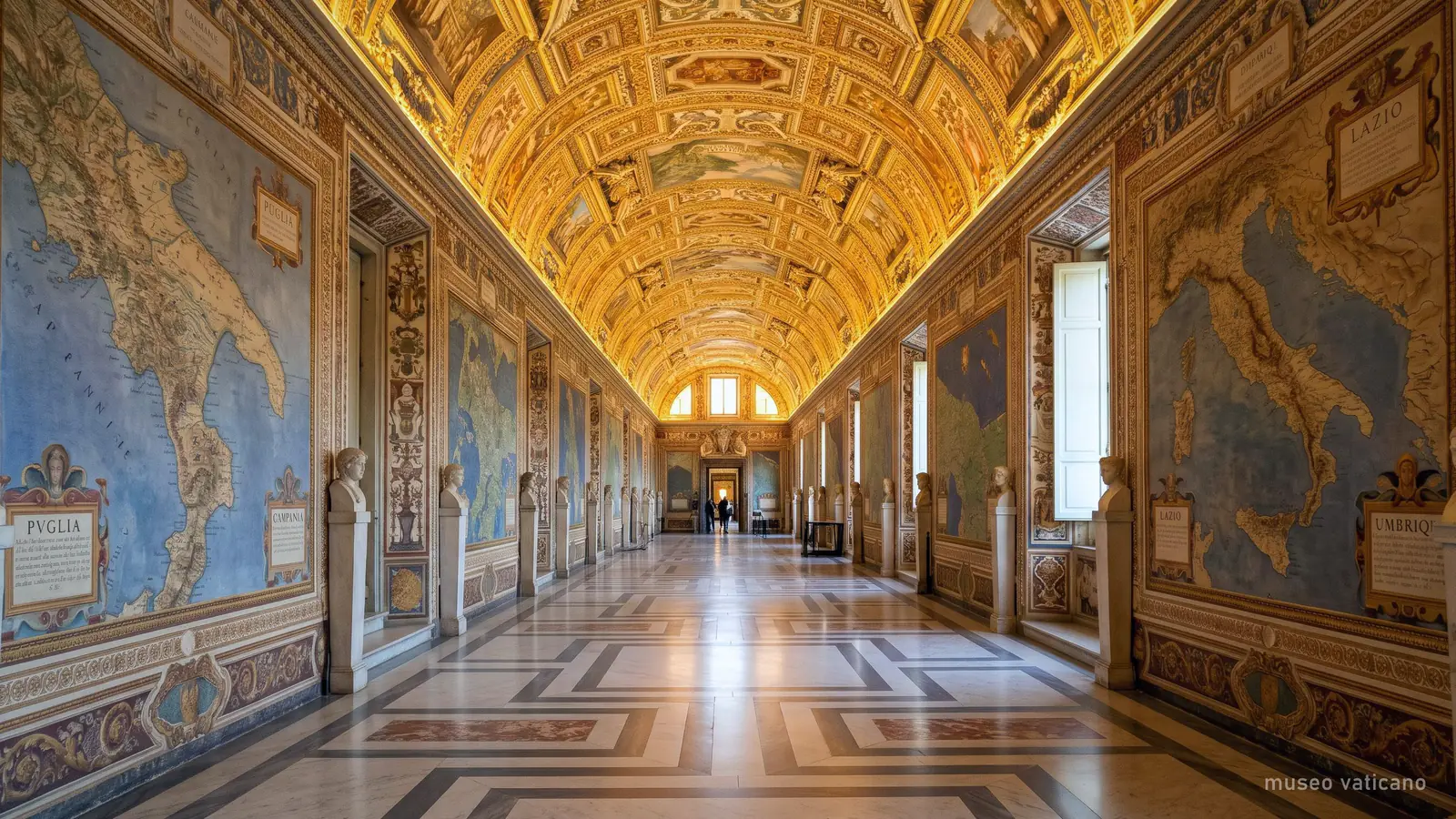
| 4. Gallery of Maps | Forty fresco maps of Italy | Painted between 1580 and 1585 |
| 5. Raphael Rooms | The School of Athens and other frescoes | Decorated between 1508 and 1524 |
| 6. Sistine Chapel | Michelangelo’s ceiling and Last Judgment | No photos, and in silence |
Two details of the route worth knowing. In the Pio-Clementino Museum the direction is the reverse of the original: today you enter through the Square Vestibule and leave through the Room of the Greek Cross. And after the Sistine Chapel, guided groups with the basilica go straight through to St. Peter’s; with an independent ticket, you leave the Museums and walk to the square.
Along the route there are cafés, a self-service restaurant and a pizzeria, because you cannot eat or drink in the galleries. Next to the Cortile delle Corazze there is a Poste Vaticane office, the Vatican’s post, where you can buy stamps and postcards.
Which works should you see in the Vatican Museums?
With about seven kilometers of rooms, seeing everything in one visit is not realistic. These are the most searched-for works, with what Wikipedia says about them. The full selection is in the Vatican Museums highlights.
Laocoön and His Sons
A 2.42 m white marble group showing the Trojan priest Laocoön and his two sons attacked by sea serpents. It has been one of the most famous ancient sculptures since it was dug up in Rome in 1506, and it stands in the Pio-Clementino Museum. It has its own guide: Laocoön and His Sons.
Apollo Belvedere and Belvedere Torso
The Apollo, a marble statue of the Greek god, has been on display since 1511 in the Belvedere courtyard, which gives it its name. The Belvedere Torso is a 1.59 m marble fragment signed by Apollonius of Athens, in the center of the Room of the Muses. Wikipedia notes that this torso is considered the inspiration for Michelangelo’s studies for the Adam of the Sistine Chapel.
Bramante Staircase
In 1507 Donato Bramante designed a spiral staircase for Julius II linking the small palace of Innocent VIII with the rest of the palaces. The story of this staircase, and of the modern ramp it gets confused with, is in the Bramante Staircase guide.
Gallery of Maps
Forty fresco maps showing the regions of Italy in the time of Gregory XIII, made between 1580 and 1585 from the cartoons of the geographer Ignazio Danti. On one side are the regions facing the Ligurian and Tyrrhenian seas; on the other, those on the Adriatic.
Raphael Rooms
Four rooms of the Apostolic Palace that Julius II chose as his residence and that Raphael and his pupils decorated between 1508 and 1524. Here is The School of Athens, painted between 1510 and 1511. We go through them room by room in the Raphael Rooms.
Vatican Pinacoteca
About five hundred paintings in eighteen rooms, arranged from the 12th century to the late 19th, with works by Giotto, Leonardo da Vinci, Giovanni Bellini, Titian and Guido Reni. The Transfiguration, Raphael’s last painting, hangs here.
Sistine Chapel
The end of the route. Michelangelo painted the ceiling between 1508 and 1512, including The Creation of Adam, and The Last Judgment between 1536 and 1541, on a wall of 13.7 × 12.2 m. All the detail is in the Sistine Chapel guide and the one on Michelangelo’s Last Judgment.
How long does it take to see the Vatican Museums?
Allow 2 to 3 hours for the Museums and the Sistine Chapel. That is how long the visits we sell last: the night tour, 2 hours; the skip-the-line ticket with a host and the ticket with the basilica, 2.5 to 3 hours. If you add St. Peter’s Basilica, combined visits last about 3 hours, and the early-access one 3 to 3.5.
Your real time is set by the opening hours. The Museums are open Monday to Saturday from 8:00 a.m. to 8:00 p.m., last entry is at 6:00 p.m., and the rooms start clearing 30 minutes before closing. If you go in at 6:00 p.m., you have an hour and a half. On the last Sunday of each month they open free from 9:00 a.m. to 2:00 p.m., with last entry at 12:30 p.m. On other Sundays they are closed.
For the rest of 2026 they are also closed on 1 November and 8, 25 and 26 December, and the Museums announce other partial closures in their official calendar. All the detail is in Vatican Museums hours and how long it takes to see the Vatican Museums.
To save time inside: decide beforehand which three or four rooms are your priority, wear comfortable shoes and leave the big bag at the hotel. Families can bring a stroller in; there are changing tables and a nursing room. More tips in Vatican Museums with children (in Spanish).
Which ticket do you need for the Vatican Museums?
A Vatican Museums ticket includes the Sistine Chapel and is valid only for the day it is issued for. The official rates are:
| Type | At the ticket office | Online |
|---|---|---|
| Full price | 20 € | 20 € + 5 € |
| Reduced (ages 7 to 18, students up to 25, priests and members of religious orders) | 10 € | 10 € + 5 € |
| Under 7 | Free | Free |
| Disability of 67% or more | Free, at the Special Permits desk | Not bookable online |
Official tickets are non-refundable, and the only official online shop is tickets.museivaticani.va. The Museums warn about websites with similar domains that charge much more. To see what you gain and lose with each channel, read the comparison of the Vatican Museums official website and the Vatican Museums ticket prices.
If the official website has no time slot left or you would rather visit another way, these are the options we link to in Vatican Museums tickets:
- Vatican Museums and Sistine Chapel ticket, from $37, rated 4.5 out of 5 in 159,426 reviews of this ticket on GetYourGuide. It is non-refundable.
- Skip-the-line ticket with a host, from $51, with free cancellation up to 24 hours before.
- Ticket with audio guide, from $42, if you want to go at your own pace with commentary.
- Vatican Museums at night, from $85, a 2-hour visit.
If you are looking for a Spanish-speaking guide, see the Vatican tours in Spanish (in Spanish). And if you are interested in getting in free, check the conditions in Vatican Museums free Sunday.
Check prices & dates
Book your tickets in advance: popular time slots sell out.
Book Vatican tickets
From$37per person
Check availability- Free cancellation on 8 of the 9 options
- Reserve now, pay later on 7 of the 9
- Compared with the official 20 € + 5 € ticket
Price checked Oct 27, 2026
Frequently asked questions
Does the Vatican Museums ticket include the Sistine Chapel?
Yes. A single ticket covers the Vatican Museums and the Sistine Chapel, which is at the end of the route. The ticket is valid only for the day it is issued for.
How many museums make up the Vatican Museums?
Wikipedia lists 27 museums, galleries, chapels and rooms, including the Pio-Clementino Museum, the Pinacoteca, the Gallery of Maps, the Raphael Rooms and the Sistine Chapel, plus two archaeological areas.
Which are the most visited museums in the world?
According to Wikipedia, in 2022 the Vatican Museums had 5,080,866 visitors and were the second most visited museum in the world, behind the Louvre in Paris.
Can you take photos in the Vatican Museums?
Yes, for personal use and without flash, along the whole route except the Sistine Chapel, where photos and video are not allowed. Tripods, drones and selfie sticks are not allowed either.
Which day are the Vatican Museums free?
The last Sunday of each month, from 9:00 a.m. to 2:00 p.m. with last entry at 12:30 p.m., unless it falls on Easter, 29 June or 25, 26 or 31 December. Lines are usually very long that day.
Sources