
informational 6 min read
Vatican Swiss Guard: History, Uniform and Where to See Them
Updated October 28, 2026
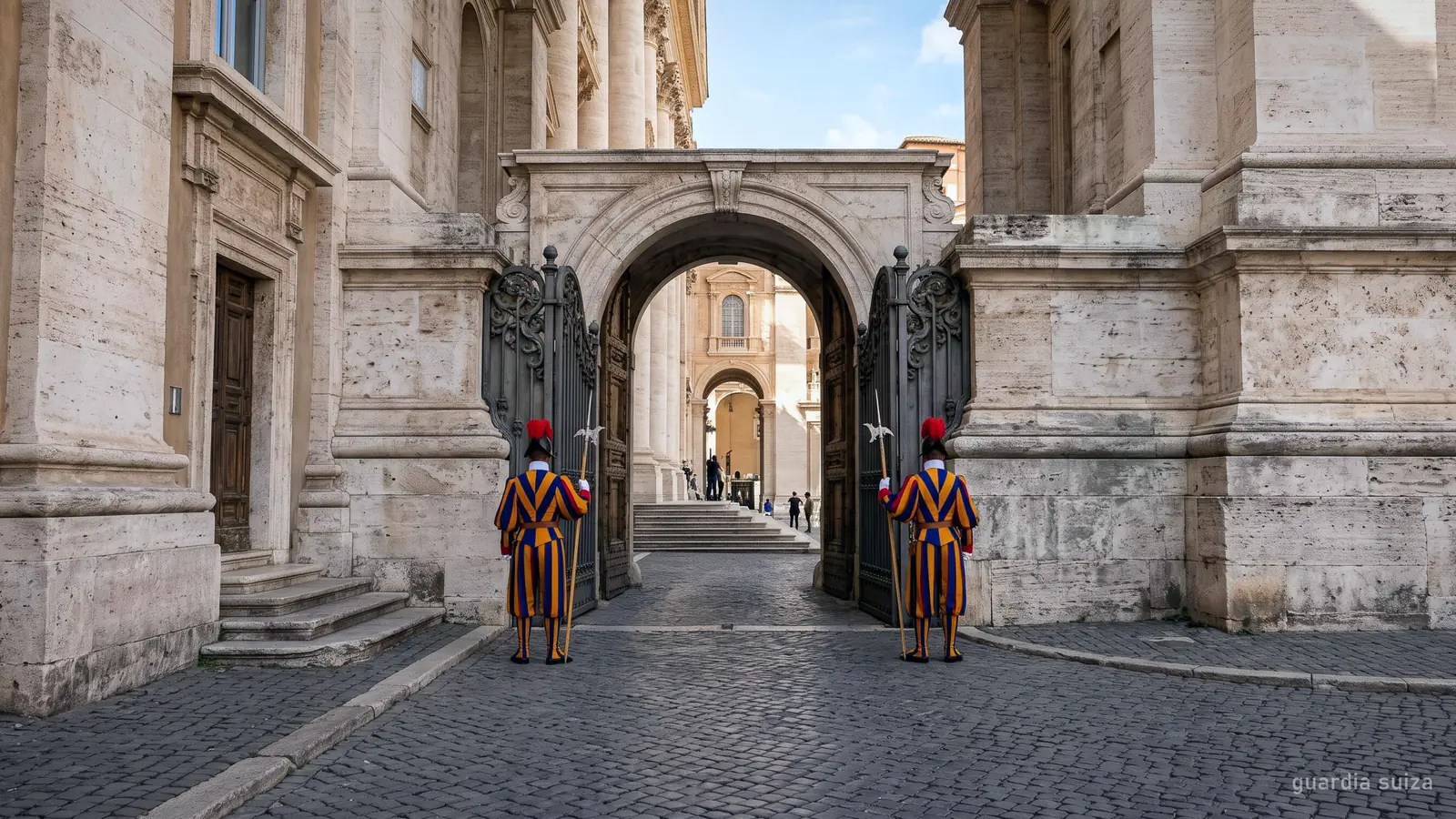
The Vatican Swiss Guard is the military corps that protects the Pope and Vatican City: Julius II created it on 21 January 1506, and today it is the smallest professional army in the world, with 135 soldiers. All of them are Swiss, Catholic and male. Their brightly colored uniform, with morion helmet and halberd, is one of the most recognizable sights of the Vatican. You will see them at the state’s entrances when you visit the Vatican.
What is the Swiss Guard?
The Pontifical Swiss Guard (Custodes Helvetici in Latin, Guardia Svizzera in Italian) is responsible for the security of the Pope and the Holy See. Its ceremonial head is the Pope, as sovereign of the state. General security of the territory, public order and traffic are the job of another corps, the Vatican Gendarmerie.
Its 135 members break down like this, according to Wikipedia:
| Rank | Number |
|---|---|
| Commander (colonel) | 1 |
| Deputy commander (lieutenant colonel) | 1 |
| Chaplain (lieutenant colonel) | 1 |
| Officer with the rank of major | 1 |
| Captains | 2 |
| Non-commissioned officers | 23 |
| Halberdiers | 104 |
| Drummers | 2 |
The state’s official website counts 120 members of the Guard among the citizens living inside the Vatican. Their barracks face the Apostolic Palace.
They train with modern weapons, such as the Swiss SIG 550 rifle, and also with the sword and the halberd. They receive close-protection training like that used to guard heads of state.
Why was the Pontifical Swiss Guard created at the Vatican?
Because popes already relied on Swiss mercenaries before creating it. Sixtus IV signed an alliance with the Swiss Confederation and built them barracks in Rome. Innocent VIII and Alexander VI also used them in the Italian wars of the late 15th century.
In 1503 Julius II became pope. He asked the Swiss nobility for men to protect him, and on 21 January 1506 a company of 150 men was formed. He chose Swiss soldiers for the reputation they had earned in the Burgundian Wars. That same year, 1506, Julius II restarted work on the new St Peter’s Basilica.
What was the Swiss Guard massacre?
That is how the battle of 6 May 1527, during the Sack of Rome, is remembered. The troops of Emperor Charles V, with some ten thousand Landsknechts, five to six thousand Spanish soldiers and a group of Italians, under the command of Charles, Constable of Bourbon, entered the city.
The Swiss Guards fought in front of St Peter’s Basilica and kept fighting as they fell back to the steps of the high altar. Of 189 guards, 42 survived. Those 42 surrounded Pope Clement VII and got him out through the Passetto di Borgo, the raised passageway leading to Castel Sant’Angelo. Captain Kaspar Röist, wounded, died at home in front of his wife.
Every 6 May, in memory of that battle, the new halberdiers swear their oath before the Pope.
Requirements to become a Swiss Guard
| Requirement | Detail |
|---|---|
| Nationality | Swiss |
| Religion | Catholic |
| Sex and marital status | Male, single |
| Age | 19 to 30 |
| Height | At least 1.74 m |
| Education | Vocational or high-school diploma |
| Military service | Basic training in the Swiss army and certificates of good conduct |
They can marry if they extend their service by two years and with the chaplain’s approval. The women who live in the Vatican include the wives of some guards.
The uniform
The current uniform is not by Michelangelo, as is often repeated. It was designed by Commander Jules Répond, who led the Guard from 1910 to 1921, drawing on Raphael’s frescoes.
- Colors. They match the livery of the Della Rovere, Julius II’s family, based on his coat of arms. The red was added by Leo X, in reference to the Medici coat of arms.
- Morion. The helmet, black or metal, resembles the one worn by 16th-century Spanish soldiers. It carries a red or white plume depending on rank.
- Officers. Their crimson uniform is based on that of the guards of the Spanish Empire in the time of Philip II.
- Ceremonial weapons. Halberd and sword. On duty they also carry modern weapons.
- Legs. They do not wear high boots, but hose fastened below the knee with a gold garter.
The Guard’s flag carries the arms of Julius II at the bottom, those of the reigning Pope at the top and those of the commander in the center.
If you want to see Swiss soldiers serving the Pope painted by Raphael himself, look for The Mass at Bolsena in the Raphael Rooms: Julius II appears kneeling beside his Swiss troops, in 1512.
Where can you see the Swiss Guard at the Vatican?
- At the state’s entrances. The Vatican is reached through five entrances, guarded by the Swiss Guard and the Gendarmerie, according to the state’s official website.
- Around St Peter’s Square. The square is open to all and patrolled by the Italian police; the entrances to the rest of the state are guarded by the Swiss Guard and the Gendarmerie. We cover it in the St Peter’s Square guide.
- At celebrations with the Pope. The Guard protects the Pope, so you will see them at ceremonies and audiences. Tickets for the general audiences are always free.
Remember that they are soldiers on duty. You can photograph them from outside, but do not try to pass through the entrances they guard: they lead to parts of the state closed to tourists.
To place the Guard in the country’s history, see the history of the Vatican and the state’s facts in our guide to Vatican City.
Check prices & dates
Book your tickets in advance: popular time slots sell out.
Book Vatican tickets
From$37per person
Check availability- Free cancellation on 8 of the 9 options
- Reserve now, pay later on 7 of the 9
- Compared with the official 20 € + 5 € ticket
Price checked Oct 27, 2026
Frequently asked questions
What is the Swiss Guard?
It is the military corps that protects the Pope and Vatican City. Julius II founded it on 21 January 1506 and today it has 135 soldiers, all Swiss and Catholic.
Why is the Swiss Guard Swiss?
Because Julius II asked the Swiss nobility for soldiers to protect him. Swiss mercenaries had been famous since the Burgundian Wars and had already served earlier popes.
What are the requirements to join the Swiss Guard?
Being male, single, Catholic and a Swiss citizen, aged 19 to 30, at least 1.74 m tall, with a vocational or high-school diploma, and having completed basic training in the Swiss army.
Who designed the Swiss Guard uniform?
Commander Jules Répond, who led the Guard from 1910 to 1921. He drew on Raphael's frescoes, not on a design by Michelangelo as is often said.
When are new Swiss Guards sworn in?
Every 6 May, in memory of the guards who died defending the Pope during the Sack of Rome in 1527.
Sources